Examples · examples/threadripper-matx/v0.3
Basalt
Basalt is a microATX motherboard for an AMD Threadripper 7000 or 9000 on the sTR5 socket (the TRX50 platform)
4 DDR5 RDIMM slots, 3 PCI Express 5.0 x16 slots, 2 M.2 sockets, 14 phases of power stages for a 350 W processor, and the rear I/O, on 244 x 244 mm. No microATX TRX50 board has been made; the smallest is ATX.
- v0.3
- 243.8 × 243.8 mm
- 10 layers
- 179 parts
- 5,915 track segments
- 5,137 vias
- GREEN (nothing to run for: sim)
Drag to turn the board. KiCad's render of it, 36 views, 10 degrees apart.
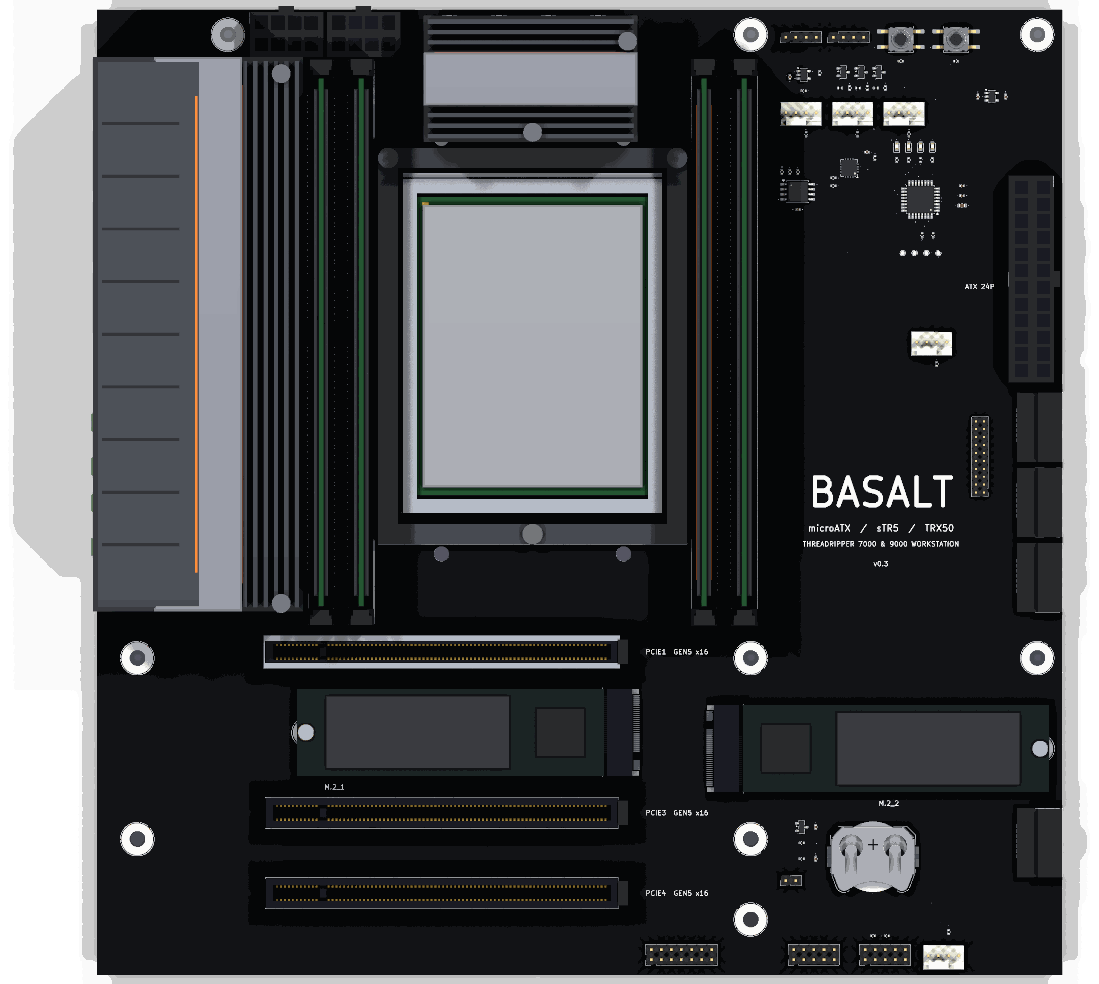
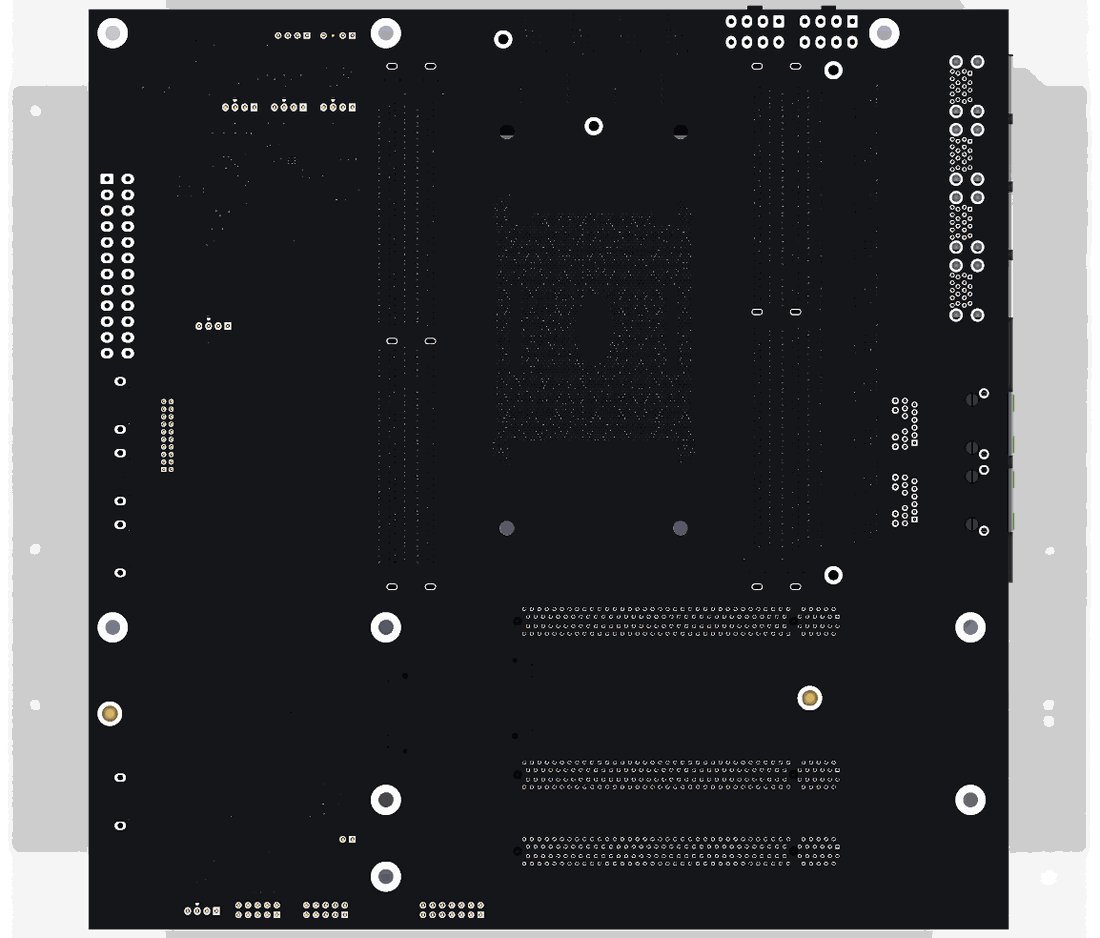
Explore the board
Every track and part of the routed board, drawn from its file
The board as examples/threadripper-matx/v0.3/basalt.kicad_pcb holds it: 10 copper layers, 5,915 track segments, 5,137 vias and 676 nets. Point at a pad to see its part, and click a track, a via or a pad to follow its connection across the board.
Drag to move. Pinch, or hold Ctrl and scroll, to zoom.
Checks
The four checks on Basalt v0.3
The verdict of the last run, as its gates report records it: GREEN (nothing to run for: sim).
- Electrical rules (ERC)0 errors, 0 warnings
- Design rules (DRC)0 errors, 0 warnings (0 unconnected, 0 parity)
- Simulation (SIM)no sim/*.cir in project
- Fabrication files (EXPORT)4/4 outputs, 30 gerber files
How it was built
Every step of the design, with what it changed
Each step as the README's "What changed" sections (v0.3/README.md) records it, oldest first.
The floor plan and the power
The first version places every part whose position the form factor or another part fixes and joins what carries power, so that each later version adds one bus to a board that is already GREEN.
The memory buses
The ports and headers
What is open
What is still to be done on this board
- The PCI Express and M.2 lanes, with the host transmitters' AC capacitors. Tried on a copy of v0.3 (
../LOOP.md, pass 12): the grid router joins 151 of the 234; the M.2 lanes need a trunk beside the slots drawn by rule, as the memory's combs are, before the slots' lanes fill the way. - The processor's slow signals: the SATA pairs (lanes in SATA mode), USB 2.0 to the headers and the board controller, SPI to the flash and the TPM, the buttons, VBAT and RTC_RST, the drive LED.
- The rear I/O's controllers, on the processor's remaining lanes.
- The board controller's firmware.
- Length tuning inside each memory byte lane (12.3 mm at most).
- The sheet: the ports' parts sit in the shelves one by one, and their wires run long; each port's parts belong in a block of their own, as each phase's are (P24 step 4).
- The socket's housing, frame and cooler holes, and the land pitch, against a socket drawing (Lotes, Foxconn; NDA).
- AMD's pin map in place of the stand-in.
Two more in its README.