Examples · examples/anc-speaker/v0.1
Hush
Hush is a speaker that listens to the room and plays the inverse wave
A ring of circuit board sits on the face of a 40 mm speaker driver. Through the ring's three windows you see the cone; at the centre, on three spokes, a MEMS microphone listens 4 mm in front of it. Two op-amps turn what the mic hears into its inverse, a class-D amplifier plays it, and a hum in front of the speaker cancels in the air: 150 Hz comes out 18.8 dB quieter where the mic listens. Music from a phone plays at the same time; the loop takes it as its target instead of cancelling it. There is no microcontroller and no firmware: the inverse is made by analog parts within a few microseconds, which a feedback loop through 4 mm of air needs.
- v0.1
- 62 × 62 mm
- 4 layers
- 62 parts
- 472 track segments
- 24 vias
- GREEN with 6 warnings
Drag to turn the board. KiCad's render of it, 36 views, 10 degrees apart.
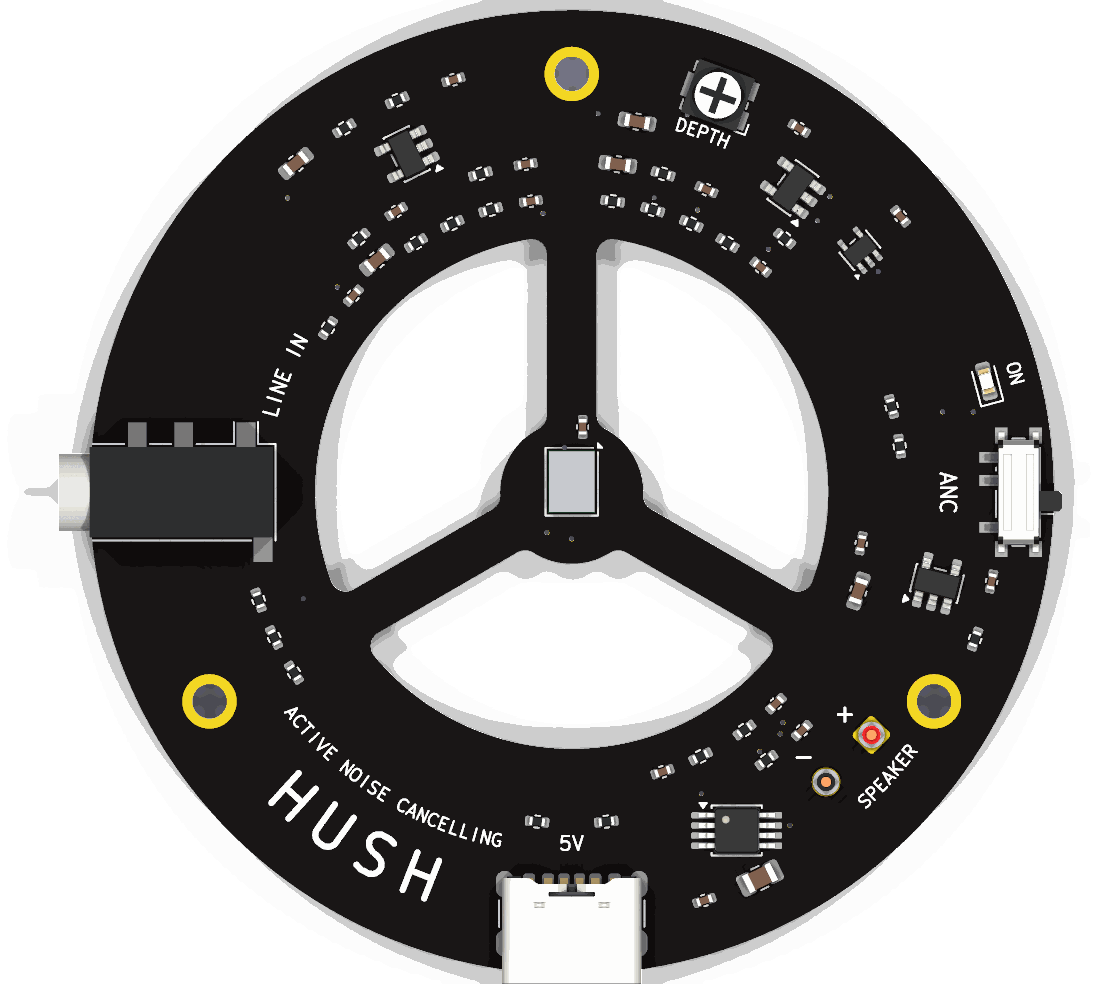
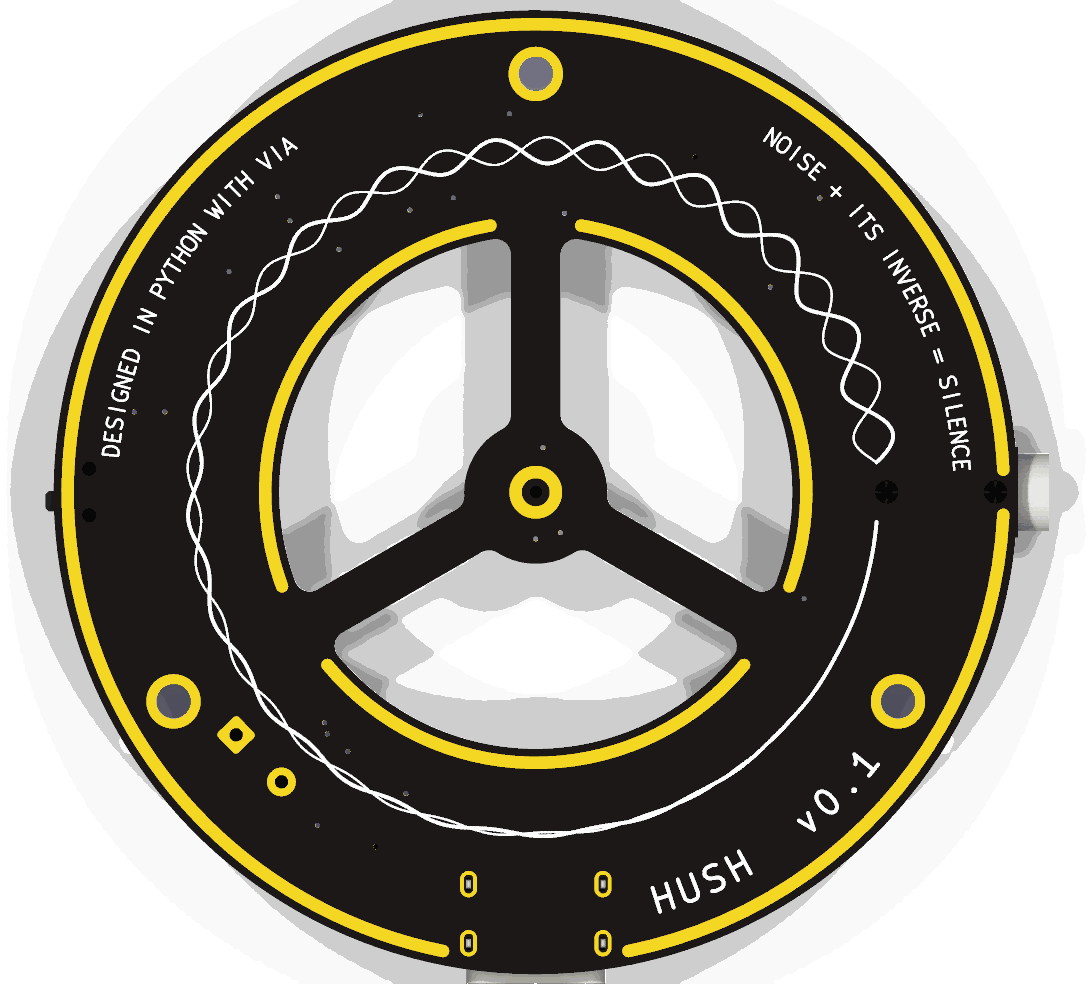
Explore the board
Every track and part of the routed board, drawn from its file
The board as examples/anc-speaker/v0.1/hush.kicad_pcb holds it: four copper layers, 472 track segments, 24 vias and 36 nets. Point at a pad to see its part, and click a track, a via or a pad to follow its connection across the board.
Drag to move. Pinch, or hold Ctrl and scroll, to zoom.
Checks
The four checks on Hush v0.1
The verdict of the last run, as its gates report records it: GREEN with 6 warnings.
- Electrical rules (ERC)0 errors, 0 warnings
- Design rules (DRC)0 errors, 4 warnings (0 unconnected, 0 parity)
- Simulation (SIM)7 decks, 986 corner runs, 0 failures, 2 warnings
- Fabrication files (EXPORT)4/4 outputs, 24 gerber files
How it was built
Every step of the design, with what it changed
Each step as the README's "What changed" sections (v0.1/README.md) records it, oldest first.
The first board
What is open
What is still to be done on this board
- The verification package (P28): requirements with their sources, a writeup per deck, the traceability table.
- A parts file with distributor prices and stock (P25), and library rows for the passives, the connectors, the switch and the trimmer (P27). Then
workcenter costsandworkcenter docswrite the version's priced list,CONTENTS.mdanddatasheets/. - rmic, the distance from the cone's centre to the mic's port: 4 mm is an estimate from the CE40-4's drawing. The corners take it from 3 to 5 mm; measure it on the first board.
- The driver's spread: the music's flatness moves with the CE40-4's own Cms, Qms and Le (Decisions). A driver measured for its parameters, or a shelf the trimmer also moves, would hold it.
- The switch's ON and OFF: SW1 is labelled ANC and D1 lights while the loop cancels. The PCM12's switching diagram, from its datasheet, says which end is which; mark them in v0.2.
- The driver in free air: the decks model the cone's front in free air. A box behind it adds its air spring to Cms and moves the resonance up: run the decks again with the box's volume.
- The quiet is largest at the mic. 18.8 dB at 150 Hz is the pressure where the mic listens; the quiet zone round it is a fraction of a wavelength (2.3 m at 150 Hz), so an ear close to the cone hears most of it. Measure it with a second mic beside the first.
- First power-on with DEPTH turned down; then up while listening for a whistle near 1.5 kHz, the loop's crossing. The speaker's polarity matters: + to + (J3's silkscreen); the other way round the loop's feedback turns positive and it whistles at once.
One more in its README.